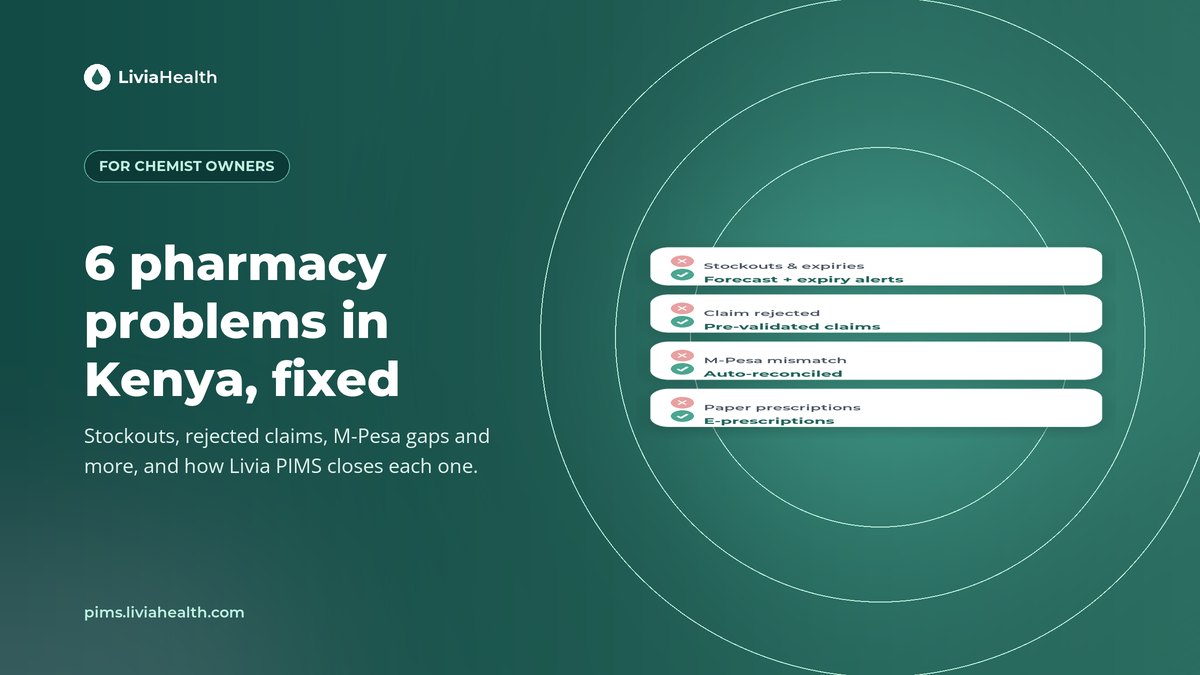
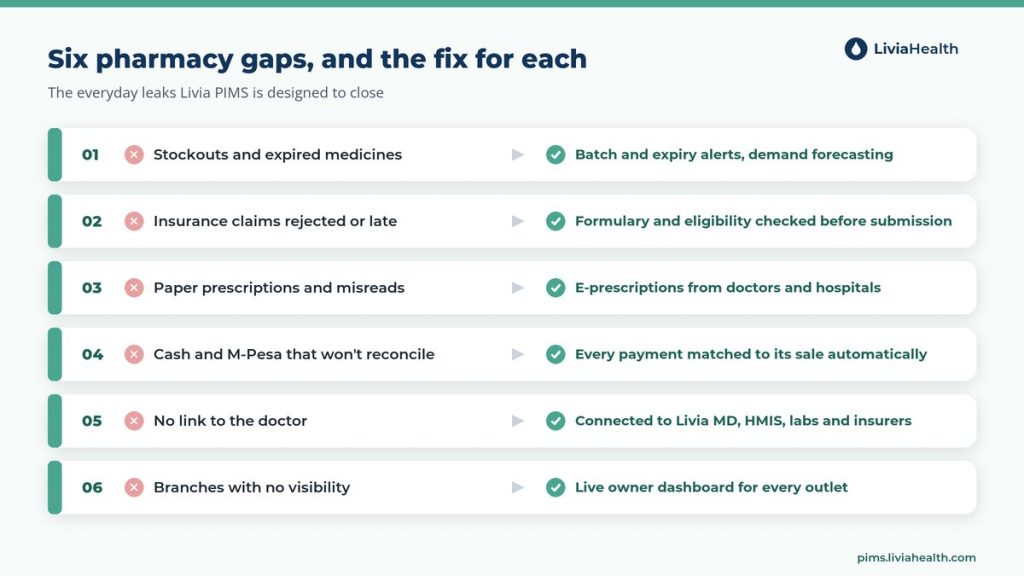
Walk into almost any chemist in Nairobi, Kisumu or Eldoret at closing time and you will see the same scene: someone counting the till, someone scrolling through M-Pesa messages, and a notebook of credit sales that never quite adds up. The biggest pharmacy problems in Kenya are rarely dramatic. They are small leaks that happen every day and quietly eat into margins. This article looks at the six most common ones and how Livia PIMS is designed to close each of them.
1. Stockouts on fast movers, expiries on slow movers
This is the classic double loss. The amoxicillin and the ORS run out on a busy Saturday, so customers walk to the chemist next door. Meanwhile a carton of a slow-moving cream sits at the back until someone notices it expired two months ago. Both problems come from the same cause: nobody has a clear, current view of what is on the shelf and when it expires.
How Livia PIMS fixes it: every product is tracked by batch and expiry date, with alerts at 30, 60 and 90 days. Demand forecasting uses each branch’s own sales history to suggest reorder points, and a slow-mover dashboard shows what to transfer to another branch or discount while it can still be sold. Cycle counts are scheduled so stock takes stop being an annual nightmare.
2. Insurance claims that take months, or never get paid
Insurance patients are good business until the claims come back rejected. A wrong member number, a drug outside the formulary, an exclusion nobody checked. Each rejection means rework, and some claims are simply written off because chasing them costs more than they are worth.
How Livia PIMS fixes it: before you submit, claims are checked against the insurer’s drug formulary, exclusions and the patient’s eligibility. Errors are caught at the counter, while the patient is still standing there, rather than weeks later in an email from the insurer. Submission takes one click, and claim status is tracked in the system. Livia Health designed this to improve first-pass accuracy, which is where most of the money is lost.
3. Paper prescriptions and misreads
Every pharmacist has squinted at a handwritten script and phoned the clinic to confirm a dose. Misreads cause dispensing errors. Lost paper means lost refills. And a patient who has a bad experience rarely complains; they just go elsewhere next time.
How Livia PIMS fixes it: e-prescriptions arrive directly from doctors on Livia MD and from partner hospitals. The drug, strength, dose and quantity are typed, not handwritten. Each patient has a profile with their dispensing history, allergies and refills, so there is a full audit trail for every prescription.
4. Cash, M-Pesa and credit sales that don’t reconcile
A typical Kenyan chemist takes money in at least four ways: cash, M-Pesa Till, Paybill and credit for regular customers, plus cards and insurance. Matching them all to sales at the end of the day is slow and error-prone, and it is exactly where staff theft hides. Owners who have tried to reconcile a month of M-Pesa statements by hand know how many hours it takes.
How Livia PIMS fixes it: cash, card, M-Pesa STK push, Paybill, Till and credit sales are reconciled automatically against each sale. A daily profit and loss summary is emailed to the owner before the next day’s opening. Livia Health estimates pharmacies can reclaim six or more hours a week that used to go on reconciliation.
5. No connection to the doctor or the patient’s history
A patient arrives with a paper prescription from the clinic across the road. You don’t know what they were prescribed last month, whether they have insurance or what other medicines they take. You are working with half the picture, and the patient’s care is split across places that never talk to each other.
How Livia PIMS fixes it: the system is part of the Livia Health network, which links Livia MD doctors, hospitals on Livia HMIS, laboratories and insurers. The goal is one patient, one history and one continuous record of care. For the pharmacy, that means safer dispensing and patients who come back because the experience is easier.
6. More than one branch, and no idea what is happening in any of them
Opening a second branch is exciting. Managing it is harder. Each outlet ends up running its own books, and the owner finds out about shrinkage, theft or poor margins weeks too late, usually when the cash runs short.
How Livia PIMS fixes it: a head-office dashboard shows live sales, stock, claims and cash for every branch. Real-time alerts flag unusual patterns that may point to shrinkage. You can transfer stock between branches, push price changes from one place and compare branches side by side, from your phone if you are on the road.
Two problems people forget to count
Beyond the six big gaps, two smaller issues cost Kenyan pharmacies more than most owners realise.
Free services. Many chemists check blood pressure, test blood sugar, run malaria rapid tests or dress wounds, then charge nothing because there is no easy way to bill it. Livia PIMS has a service catalogue with per-branch prices, so each service becomes a line on the bill and on the eTIMS invoice.
Tax compliance. KRA now expects every business to issue electronic tax invoices through eTIMS. Doing that with a separate device or provider adds cost and another system to manage. Livia PIMS is built to support eTIMS workflows from the same till. Our guide to eTIMS for pharmacies explains what that involves.
Why these problems keep coming back
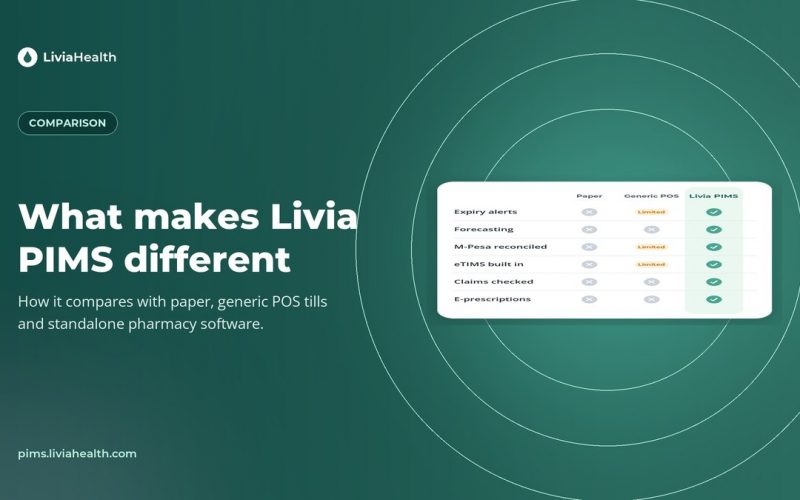
Most pharmacies try to fix these issues one at a time: a better till here, a stock spreadsheet there, a WhatsApp group for supplier orders. The trouble is that the problems are connected. A stock error becomes a claim error, which becomes a reconciliation error. Fixing them in separate tools moves the problem around rather than solving it. That is the case for a single system, and it is why we explain what makes Livia PIMS different from other pharmacy software in a separate article.
Fixing pharmacy problems in Kenya: where to start
You don’t need to fix everything at once. Start with the problem that costs you the most. For most single-branch chemists that is stock and expiry. For chains it is usually visibility and reconciliation. Livia Health offers a free workflow audit with every demo, which is a useful way to see where your own leaks are. Request a Livia PIMS demo or read what Livia PIMS is and how it works.
Frequently asked questions